
Relocation guide
Relocating to the Triangle? Here is what to know before you move.
Ready to trade long commutes for a region with room to breathe? Whether you are moving from across the country or across town, here is a practical overview of life in Raleigh, Durham, Chapel Hill and the communities around them, and how to plan your move.

Why people choose the Triangle
A region with room to live well.
The Triangle blends city energy with a smaller-town feel. Here is what newcomers often tell us they notice first.
A central location
Raleigh-Durham International Airport, regional airports, two ports and several major interstates put the Triangle within easy reach of the East Coast and beyond.
Parks and greenways
Raleigh alone has more than 100 miles of greenway trails and over 200 parks, with more green space throughout the region.
Four seasons
Generally mild springs and autumns, warm summers and short, mild winters.
Education and research
Duke, NC State and UNC Chapel Hill anchor a region full of colleges, community colleges and research institutions.
Healthcare access
The region is home to major medical systems and teaching hospitals within a short drive of each other.
A range of homes
From established neighborhoods to new construction, townhomes to homes on larger lots, the region offers a wide variety of home types.
Figures and descriptions are general and change over time. Ask us for the most current information.
Where we work
Communities across the region.
We help clients buy, sell and build across Wake, Durham, Orange and Johnston counties, and in nearby communities such as Pittsboro and Youngsville.
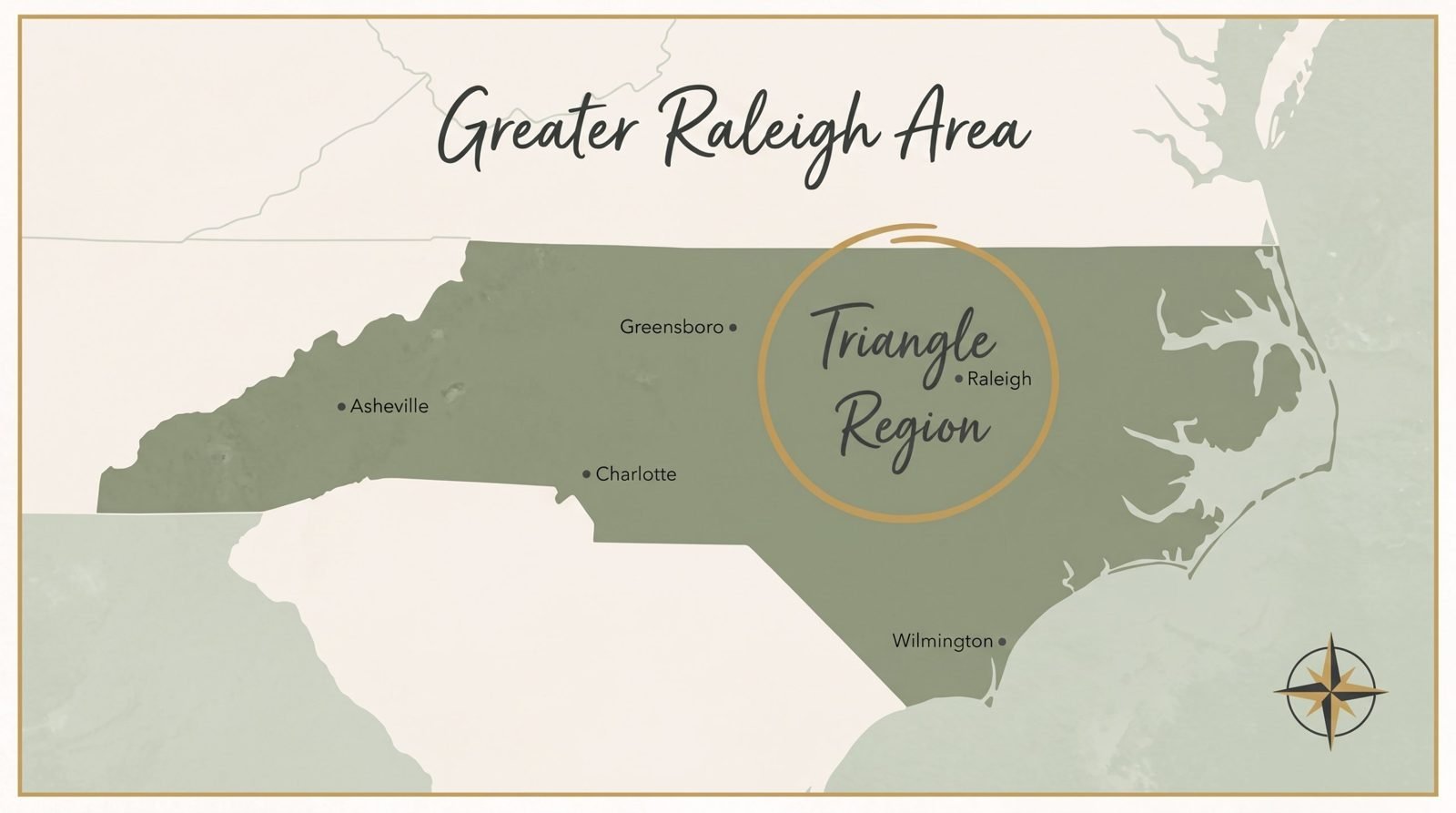
Each community has its own mix of housing, commute patterns and amenities. We help you compare them using the criteria that matter to you, such as budget, commute, lot size, age of home and access to outdoor space.
Types of homes
What you will find here.
Established homes
Mid-century and older homes closer to the urban core often offer mature trees and character. Ask about HVAC, plumbing, insulation and moisture history.
Newer subdivisions
Homes built in recent decades often have modern systems and open layouts. Ask about ventilation design, builder warranties and homeowners association rules.
New construction and custom
Building from a builder’s plans or on your own lot offers the most control. See our questions to ask your builder.
Townhomes and condos
Lower-maintenance options in many communities. Ask about shared walls, ventilation and association fees.
Homes on larger lots
Outlying areas may offer more space and, in some cases, private wells and septic systems. Ask for test records.
Local things worth asking
Healthy-home questions for this region.
- Moisture and humidity: how are crawlspaces, drainage and HVAC handled?
- Radon: has the home been tested? North Carolina has an official radon program with test information.
- Water source: is it public water or a private well, and when was it last tested?
- Age and systems: when were the roof, HVAC and plumbing last updated?
- Outdoor space: how will you use the yard, porch or patio through the seasons?
Educational only. A licensed home inspector and qualified testing professionals can evaluate any specific home.
Relocating
A calm path to a new home base.
We get calls and emails every week from people planning a move to the area. Whether you are moving this month or sometime this year, we can help you make it a smooth one.
Mindful Moves does not steer clients toward or away from any community. We provide objective information and serve every client equally.
Good to know
Relocation questions
What is the Triangle?
“The Triangle” refers to the Raleigh-Durham-Chapel Hill area of North Carolina, named for the three research universities and the Research Triangle Park between them. Wake, Durham and Orange counties are at its core, and nearby communities in Johnston and other counties are often included.
Should I worry about moisture in Triangle homes?
North Carolina’s climate is humid, so moisture management matters. Ask about crawlspace or foundation conditions, drainage, HVAC sizing and any history of water intrusion, and have a licensed inspector evaluate the home.
Will you tell me which community is best for me?
We provide objective information and help you apply your own criteria, such as budget, commute, home type, lot size and access to outdoor space. We do not steer clients toward or away from any area, and we serve every client equally under fair housing laws.
Can you help me buy a home before I move?
Yes. Many clients tour by video, then visit for a focused weekend. We help you plan the search, the visit and the timing.
Can you help me sell my current home and buy here?
Yes. We help you coordinate timing so one move supports the other, whether you are selling nearby or across the country.
Next step
Tell us about your move.
Share a few details and we will set up a short, no-pressure call to talk through your options.
- No pressure and no obligation
- We listen first, then recommend
- You leave with a clear first step
Thank you, .
Your note is in. We typically reply within one business day.
While you wait, you might like our healthy home buyer checklist or questions to ask your builder.
Preview mode: nothing was actually sent.